Archive for the 'IranMap' Category

Jan 16 2012

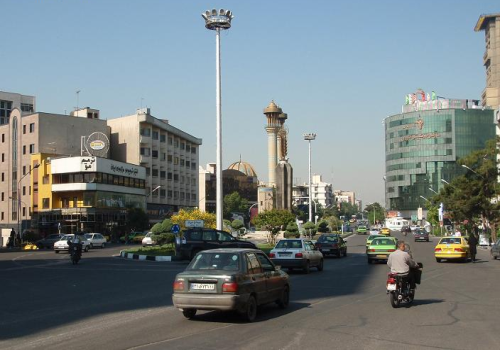
Tehran’s Wilting Plane Trees

Last year, the environmental activists in Iran were shocked to receive the news of the passing of Yaser Ansari Kojuri, the director of the Sabz Press News Agency. Tragically, he passed away at thirty-two years of age due to a sudden heart attack, with no prior history of illness.
Approximately ten years ago, the late Ansari, along with a group of friends and like-minded people, founded the Iran Society for Development of Landscape and Environmental Conservation (ISDLE). The ISDLE was among Iran’s most active civil organizations in the field of environmentalism. In 2008 Ansari also established the Landscape and Environmental News Agency of Iran (Sabz Press). His efforts in both institutions left behind an impressive legacy.


High speed | Low speed

This multimedia report is the product of a conversation with the late Ansari on the subject of the rapidly dwindling number of plane trees on Tehran’s famous and beloved Valiasr Avenue due to climate change, deliberate destruction, and other human factors.

The contention over the plane trees is an issue that has recurred many times since the early nineteenth century. History even records an instance where Reza Shah ordered that attention and resources be lavished on the trees in the dead of winter, though some street sweepers would instead girdle the trees for eventual use as firewood. Today, nearly seventy years later, the contention continues. The street sweepers have given way to boutique owners some of whom apparently use quick and efficient methods to dry out the trees in order to clear the view of their storefronts. Meanwhile, many of Tehran’s city officials are content to find any suitable excuse to turn dead trees over to the saws of municipal employees.
 

In this report, Yaser Ansari Kojuri calls for a coordinated policy to protect the plane trees of the iconic Valiasr Avenue in Tehran.
Source: jadidonline.com

No responses yet

Jan 15 2012

This week photos from Iran (Week 03-2012)

Week 03-2012, Weekly Photos Selection, from IranMap-Flickr group

Imamzadeh Hossein - قزوین : امامزاده حسين

Picture 1 of 5

Imamzadeh Hossein, Qazvin, Qazvin Province, Iran - by Bijan1351

Large size | More photos from Iran

No responses yet

Jan 13 2012

Google’s Indoor Location

Recently Google launched indoor maps and indoor location for its Android operating system. The system offers a map that pinpoints details inside buildings (shops in a mall, etc…) as well as an improved Wi-Fi triangulation system that brings accuracy down to a few meters and position you at the exact floor level.

Indoor location is basically made of two components: map content in one hand and location engine in the other hand. These components are often provided by two different types of companies. Because GPS and Glonass are not working indoor, other types of technologies are offered by a number of companies to provide the positioning of mobile devices: Wi-Fi RF fingerprinting & triangulation (Cisco, Pole Star, Navizon), Bluetooth (NAVTEQ/Nokia), Cellular signal (GloPos), GPS Pseudolytes (Insiteo).

In addition, some companies like CSR/SiRF with its SiRFusion platform are willing to fuse several techniques/sensors to provide the best positioning depending on the sensors available. As it comes to indoor maps providers, there are several of them such as Micello, Point Inside, What A Map and of course NAVTEQ who came late to the game. There are also players which specialize in vertical markets. For example, aisle411 provides store maps and in-store navigation for retailers such as Home Depot or Lowe’s as well as grocery stores in a dozen of U.S. metropolitan markets. FastMall is, as the name implies, specializing in shopping malls maps and navigation.

Before talking about the impact of Google it is interesting to understand the business models and go to market strategies of the players in this market segment. There are basically two ways to monetize indoor location. One is to work directly with venue owners to provide them with tools to offer maps and navigation to their visitors and, sometimes, to track these visitors behaviours. In this category the business model is traightforward: the venue owner supports the cost of the system and offer it as a value added service.

The second type of business model is to provide a service directly to consumers with a mobile app. This type of model requires scale and the monetization is likely to come from advertising. this is where Google is obviously playing. It is therefore interesting to understand that many players are not really afraid of Google because they not directly compete against the web giant.
This is the case for WiFi positioning provider Pole Star. According to its CEO Christian Carle, “Google’s announcement creates great opportunities. It demonstrates to Pole Star’s prospects and customers that indoor positioning and mapping have great value. For Pole Star, it reinforces the value of our high accuracy positioning technology. Google educates on “Where Am I?”, Pole Star’s technology enables step-by-step guidance for users and advanced marketing services to our customers. Moreover, this creates a need for apps with maps whose specific look and feel are able to convey the image of the brand.“

According to Todd Sherman Chief Marketing Officer at indoor map vendor Point Inside, Google is silently building a system that is threatening retailers because it could easily allow in-store marketing from competitors.
“A customer inside a store is a high-value target for advertisers and a lucrative revenue opportunity for Google. It is likely that Google’s indoor maps will operate with Google’s very successful AdWords model where algorithms decide which ads to present and are biased toward the highest bidder – which can easily be a competitor.“

The key here is that indoor location is one of the technologies where brick & mortar players collides with the web giants. Everything indicates there will be a battle over who is going to own the smartphone experience in-store and in-mall. To some extend it is not very different of the battle launched by Amazon against brick and mortar stores with its price check app that is offering a 5 percent discount on any product scanned at a retail location. Small players in the indoor location market might therefore find a good business working with retailers to enable their own indoor maps and navigation applications that will compete with Google products.

“Still at a nascent stage“
Nevertheless, this market is still at its very early days; even Google does not have much to offer yet with only a few location mapped. As noticed by Patrick Connelly, analyst with ABI Research, “A tranche of new technologies from CSR, Nokia, Google, Ericsson, Mexens Technology, NextNav, and Boeing have all been launched over the last three months to help unlock the potential of indoor location and marketing. However, it will take a few years for these technologies to proliferate; indoor mapping has yet to reach anywhere near a critical mass and the ability to build relevant indoor information, marketing, and advertising is still at a nascent stage.“
Source: gpsbusinessnews.com

No responses yet

« Prev - Next »